 Unique, One-of-a-Kind Settings for Unique, One-of-a-Kind Stones
Cabs T-Z
Cabochons Index by Name
A B C D E F G H I J K L M N O P Q R S T U-V W X-Y-Z
Tenorite- Mohs 3.5
Tenorite is a copper oxide with a grey-black color. It is often found intermixed with chrysocolla, azurite, and malachite.
Tiffany Stone
Bertrandite - Beryllium Ore - Purple Opal - Ice Cream Opalite - Opal Fluorite - Opalite - Opalized Fluorite - Utah Lavendar
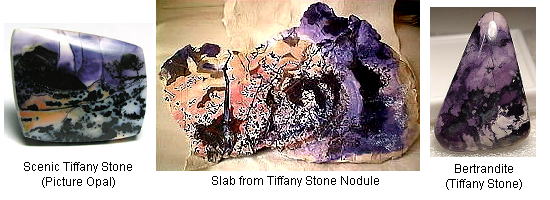
This rock is composed of many different minerals, which vary from sample to sample. It is found in nodules and you have no idea what it is going to look like until you break them open. It is found in the west desert of Juab County, Utah, near Spor Mountain (in the Thomas Range), in a small area where they mine for beryllium. It is very rare, both because it comes from such a small geographic area and because much of it ends up in the ore crusher and gets destroyed. "Old stock" relied on people being allowed to collect the rock off private land. "New stock" is being made available by the owners of some private mines.
People use all sorts of different names for it, two of the most common being bertrandite and beryllium ore. But calling it either of those names is kind of like referring to lapis lazuli as pyrite or pyrite ore. Sure, lapis may have pyrite in it and tiffany stone may have bertrandite in it, but neither are the major mineral comprising the rock.
Tiffany Stone is the only name that it is known by that is not trying to pin-point what the rock is comprised of. Some say the name tiffany stone came about because the slab slices cut from the nodules reminded the miners of tiffany glass lamp shades. Others say the name tiffany stone came about because of a miner that used to pick up the nodules for his daughter Tiffany. In either case, it is a name that people recognize in association with the nodules.
Tiffany Stone can be a soft to hard opalized stone that forms in very small to very large (100+ pound) "mineralized nodules", composed predominantly of opalized fluorite (blues, purples and whites), often with many other minerals such as quartz, chalcedony, dolomite, rhodonite, manganese oxides (blacks), bertrandite, beryl, solid white or translucent-yellowish opal, and other surprises included. The best pieces for cabs are the opalized pieces, which cut well and take a beautiful polish.
Some other tidbits about tiffany stone -
~ Tiffany Stone formed from water circulating underground, eventually penetrating nearby volcanic tuff layers and precipitating out as fluorite-rich siliceous nodules. The nodules consist mainly of quartz, chalcedony, agate and opal, but the waters also contain numerous other elements that were picked-up as the water passed through other rock within the area. Only 75% of the siliceous nodules contain fluorite, and the nodules that do contain it vary considerably in total fluorite content. The color of the fluorite varies from a light blue to a deep reddish-violet color to pink and red. Slicing open the nodule often shows a wide variety of aesthetic and colorful patterns.
~ Mineralized nodules are locally abundant in beryllium ore and represent altered clasts (fragments) of carbonate rock. Other clasts, of quartzite, limestone, and volcanic rocks, are little altered. Carbonate clasts show the alteration sequence dolomite-calcite-chalcedonic quartz/opal-fluorite. Some of the nodules have a very nice concentric structure, with an interior of calcite, an intermediate shell of gray to black chalcedony, and an outer, white to purplish layer of opalized fluorite.
~ Bertrandite is a colorless, white, yellow, or light pink mineral that contains beryllium and is what the mine is seeking as a raw ore. The beryllium processed from the bertrnadite is used in the production of missile nose cones (it does not heat up at high speeds) and other high-tech metallurgical uses. Some say the beryllium is concentrated in the fluorite (probably how the purple rock became known as bertrnadite), as microscopic inclusions of the bertrandite crystals, with generally not more than 1% bertrandite present. Others say the bertrnadite is found in the soil and the nodules are just dug up as the bertrandite is dug up. My guess is that both are true.
~ In either case, while mining for the bertrandite, the tiffany stone nodules are dug up and end up in the overburden (mining leftovers) and/or go through the ore crusher, to extract the 1% to 2% beryllium contained in the opal tuff. The end result is that not only are Tiffany Stone nodules rare because of their limited geographic location, they are made even more rare (and consequently expensive) because so few of them ever "escape".
Tiger Eye - (Tiger-Eye, Tigers Eye, Tigereye, Tiger’s Eye) - Mohs 6.5-7
Additional varieties: Hawks Eye, Tiger Iron, Marra Mamba, Pietersite
What all of these have in common is that light glides across the surface as the stone is moved, lighting up sections of the stone. This effect is called chatoyancy and is caused by the asbestos in these stones.
Where these stones differ is the colors and patterns.
The Progression:
These rocks start with hawk’s eye. The chatoyancy is created by microscopic fibers of crocidolite encapsulated within quartz.
Crocidolite (blue asbestos) is a gray-blue to green fibrous form of the amphibole mineral riebeckite. Blue (and the more rare green) tiger’s eye has preserved the original color of the riebeckite. As you move the stone, the crocidolite fibers come into a reflective orientation with your eye and bands of color illuminate. When you rotate the stone into a non reflective orientation, the bands become dark.
Crocidolite is an iron sodium silicate and as the iron oxidizes, it becomes golden brown, creating the golden brown tiger eye most people are familiar with.
Pietersite is then formed by a process known as brecciation. The fibrous structure of hawks eye and tiger eye are broken up via the earth’s geologic process. The tiny fragments are later cemented back together naturally by quartz, creating a stone with multiple hues and superb chatoyancy. The chatoyancy is no longer in bands, but occurs in swirls and patches.
Pietersite, first found in Africa, gets its chatoyancy from crocidolite. Pietersite later found in China is slightly different from the African variety, both in color and in the type of asbestos causing the chatoyancy. In additon to (or perhaps instead of) crocidolite, it has other asbestos fibers like chrysotile and torendrikite.
Chrysotile is a fibrous form of serpentine. Individual fibers are white and silky, but the aggregate in veins is usually green or yellowish. Torendrikite is an amphibole asbestos and is dark blue.
The Varieties:
Tiger Eye is fairly well known by many people. It is a gold and brown stone and is cut to emphasize the bands that light up across the stone. Where possible, it is cut to show off a "cat’s eye" - just a slit of golden color in the middle of an oval stone. However, multiple bands and wider bands create very pretty stones.
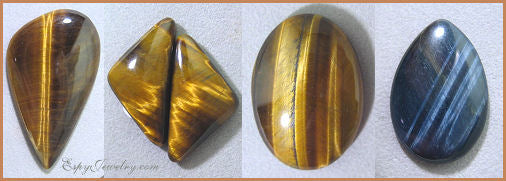
Hawks Eye is a blue variant of tiger eye. (Last image above.)
Green Tiger Eye is natural, but rare.
Red Tiger Eye - meaning a uniformly red stone with an appearance like the golden tiger eye or the blue hawks eye, is due to heat treatment, either by man or by nature, as in a hot brush fire.
Australian Tiger Iron -

In the Pilbara region of Western Australia. Tiger Eye is found intermixed with hematite and iron pyrite in a magnetitie rich, red/brown/black host rock called jaspillite. There are 2 commercially important Banded Iron Formations there, called the Brockman Iron Formation and the Marra Mamba Iron Formation.
The safest name for the material is Australian Tiger Eye, but it is quite distinctive looking and normally gets called Australian Tiger Iron. I’ve seen the highly striated material referred to as Tiger Iron Matrix.
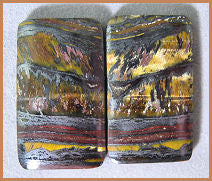
Other names also get attached to Australian Tiger Eye, some based on where it came from and some based on coloration. The terms Brockman Tiger Iron and Marra Mamba Tiger Iron imply that the tiger iron is from those specific formations. The first 3 pictures of tiger iron are pieces from the Marra Mamba formation. However, many people argue that the term Marra Mamba should only be applied to tiger iron that meets a specific coloration.
The term Marra Mamba (often mispelled as mara mamba) is now pretty much reserved for the "non-golden" tiger iron from the marra mamba formation. It was mined from isolated pockets that have been mined out, although new deposits could be found. It is richly colored - browns, reds, blues, greens, mustards, silvers - and highly chatoyant.
Pietersite -
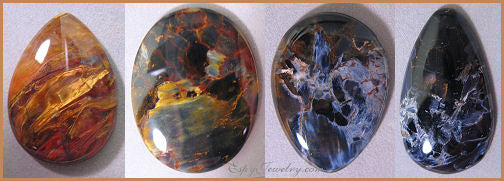
Pietersite is found in South Africa (Nambia) and China (Henan Province). It is brecciated, which means that somewhere along the line it got broken up, mixed up, and recemented by silica. The result is that the chatoyancy, instead of going in bands, goes in swirls and other patterns.
The colors range from midnight blues to browns, reds, yellows, and sometimes greens. The colors are often intermingled in swirled patterns. The Chinese variety has more red and golden/red combinations.
Tiger Iron
See Australian Tiger Iron under Tiger Eye.
Tile Ore
See Cuprite.
Tourmalated Quartz
Clear quartz with inclusions of black or dark green tourmaline needles.
Trent Sagenite - Mohs 6.5 - 7
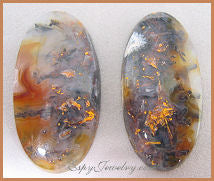
Sagenitic Agate from Trent, Oregon. The bright brassy oranges in the stone are realgar and the blacks are stibnite. There could also be some pararealgar, which forms as realgar degrades, and some orpiment, a yellow to orange-yellow arsenic sulfide that normally occurs with realgar.
Turquoise - Mohs 6

Turquoise brings thoughts of sky blue blue stones set in Southwestern Native American silver jewelry to most Americans, but turquoise is found many places in the world, where it is normally set in gold. Turquoise can range in color from pale blues to darker blues to blue-greens, yellow-greens, and even bright apple greens.
The stones above show some of the range of colors. Moving from left to right, the first is a natural stone from Tibet. The second, a stabilized stone from the #8 Mine in Nevada. The third is a natural stone from the White Horse Mine in Nevada. The fourth is a stabilized stone from Mexico.
Turquoise is a hydrated copper aluminum phosphate which formed as water trickled through host rock for millions of year. Copper created the blue colors. As the water percolated through the stone, it also brought other minerals that created different color shades. Iron can take the place of the aluminum, creating green colors. Zinc can take the place of the aluminum, creating yellow-green colors. Turquoise color can also change to darker, duller, greener colors through the effect of heat, light, detergents, oils, liquids, cosmetics, and other things it may come in contact with when worn 24/7. So basically you probably want to treat natural turquoise like you would pearls.
Turquoise must have copper, aluminum, and phosphorus. Other elements can also sneak in and create varying colors as well as technically different minerals. The minerals faustite (yellow-green hydrated copper zinc aluminum phosphate), chalcosiderite (green hydrated copper iron phosphate), and variscite (green hydrated aluminum phosphate - no copper) occur with turquoise and can get marked as turquoise. Faustite and chalcosiderite are referred to as members of the "turquoise group", you can’t tell the chemical differences simply by looking at them, and you certainly would not destroy a finished stone just to chemically test it. Variscite is normally identified as variscite, but when it comes out of a turquoise mine, it can be misidentified and no one seems to get too upset. So the name turquoise seems to be pretty much considered generally acceptable for all of these minerals when they come out of a turquoise mine. You will also see the term variquoise used to describe material where variscite and turquoise are intermingled.
Turquoise has historically been a very popular and expensive gem, so it has been imitated. It can be a bit intimidating to buy because there are so many people that are not necessarily upfront about just what they are selling. To some extent, price can tell you about the quality, in that you get what you pay for.
Color and pattern always play into value - and each person has their personal favorites. In general, "robin’s egg blue" without matrix will be the most expensive. Rarer colors like bright apple greens can be pricey. Matrix in pleasing patterns will be more expensive than blotchy matrix.
Natural stones that are dense enough and hard enough for use in jewelry will be the most expensive stones. "Natural" refers to stones that have only been cut and polished by man. Iran has been known for centuries for producing fine quality, natural turquoise. Fine quality, natural stones are also found in the US. US production is from small, normally family-owned mines with heavy use of hand labor, so quantities available on the market are normally limited.
Softer stones must be "stabilized" to be used for jewelry. Stabilized stones are fairly common. Softer, chalkier stones are impregnated with an clear epoxy which improves their hardness and durability. As the stone is no longer porous, the color is not as prone to change.
I tend to buy stones from Nevada and Arizona where I am buying close to the mine - sometimes from the mine owners and sometimes with one lapidary in between the mine and my purchase. These mines are small operations and it is easy to talk to people that really know their product. This allows me to be comfortable that I am correctly representing the stones in my pieces.
Some lapidaries apply "backing" to stones prior to cutting them, to prevent cracking of thin veins, etc when they are cut. I tend to stay away from stones with backing, as many people that buy stones for metaphysical reasons want the stone to be able to touch their skin, however I do buy a few.
You might also see black magic marker on the back of some of the natural stones. I can not get this off with my normal cleaning methods and don’t want to try anything too drastic on the natural turquoise. In most cases, the number is the carat weight of the stone. (Lapidaries expect that the back of a stone will be covered by the setting and writing on it will not be seen, but that is not the case with wire jewelry.)
Other options on the market, that I ignore for my use -
Variquoise
Variquoise is a term used to describe material where variscite and turquoise are intermingled .
Variscite (Utahlite, Lucinite)- Mohs 3.5-5
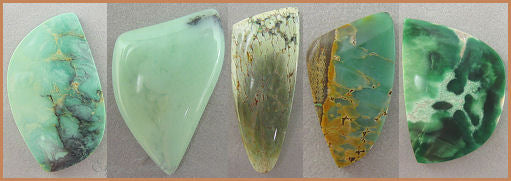
Variscite (green hydrated aluminum phosphate - no copper) is similar to turquoise (blue hydrated copper aluminum phosphate), but it doesn’t have any copper to give it a blue color. The color comes from chromium and can range from light green to dark emerald green, bluish-green, and yellowish green. The stones I have purchased have been from the southwest US and Australia.
Also see turquoise.
Verde Antique
Verde Antique is a green serpentine with white streaks that are normally calcite.
Victoria Stone (Imori) - Mohs 5.5-6
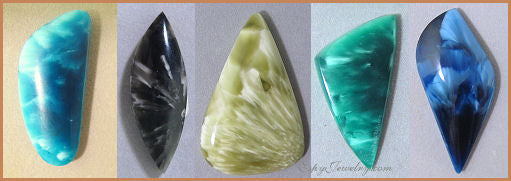
Victoria stone (also called imori) is a man-made stone created by Dr. Imori. Made starting in the 1960’s to perhaps as late as the 1980’s, Dr Imori did not share his formula with anyone, dying without passing on his knowledge. The result is that victoria stone is pretty rare and hard to find today.
Although victoria stone is man-made, it was created from natural minerals such as quartz, fluospar, feldspar, magnesite, and calcite. The minerals were fused together (melted) and then somehow made to crystalize and reform into a new "rock". The stone has a "fibrous aggregate structure", creating wonderful patterns and chatoyancy when cut to its best advantage.
Although I usually do not use man-made cabochons, these are just too wonderful to pass up. Victoria stone was made in 15-20 colors, but my favorites are the vibrant greens and blues. There are still lapidaries out there with stocks of the rough, and I keep my eye out for cabs they cut as I go to the various gem shows.
Williamsite
See Serpentine.
Zoisite- Mohs 6.5
Gem grade zoisite doesn’t normally go by the name zoisite, except for ruby-zoisite (anyolite), where the zoisite is an opaque green color.
Other gem varieties -
Tanzanite - transparent blue
Thulite - opaque pink
Small quantities of transparent zoisite varieties in other colors have been found.
Cabochons Index by Name
A B C D E F G H I J K L M N O P Q R S T U-V W X-Y-Z
A B C D E F G H I J K L M N O P Q R S T U-V W X-Y-Z
T
Tenorite- Mohs 3.5
Tenorite is a copper oxide with a grey-black color. It is often found intermixed with chrysocolla, azurite, and malachite.
Tiffany Stone
Bertrandite - Beryllium Ore - Purple Opal - Ice Cream Opalite - Opal Fluorite - Opalite - Opalized Fluorite - Utah Lavendar
This rock is composed of many different minerals, which vary from sample to sample. It is found in nodules and you have no idea what it is going to look like until you break them open. It is found in the west desert of Juab County, Utah, near Spor Mountain (in the Thomas Range), in a small area where they mine for beryllium. It is very rare, both because it comes from such a small geographic area and because much of it ends up in the ore crusher and gets destroyed. "Old stock" relied on people being allowed to collect the rock off private land. "New stock" is being made available by the owners of some private mines.
People use all sorts of different names for it, two of the most common being bertrandite and beryllium ore. But calling it either of those names is kind of like referring to lapis lazuli as pyrite or pyrite ore. Sure, lapis may have pyrite in it and tiffany stone may have bertrandite in it, but neither are the major mineral comprising the rock.
Tiffany Stone is the only name that it is known by that is not trying to pin-point what the rock is comprised of. Some say the name tiffany stone came about because the slab slices cut from the nodules reminded the miners of tiffany glass lamp shades. Others say the name tiffany stone came about because of a miner that used to pick up the nodules for his daughter Tiffany. In either case, it is a name that people recognize in association with the nodules.
Tiffany Stone can be a soft to hard opalized stone that forms in very small to very large (100+ pound) "mineralized nodules", composed predominantly of opalized fluorite (blues, purples and whites), often with many other minerals such as quartz, chalcedony, dolomite, rhodonite, manganese oxides (blacks), bertrandite, beryl, solid white or translucent-yellowish opal, and other surprises included. The best pieces for cabs are the opalized pieces, which cut well and take a beautiful polish.
Some other tidbits about tiffany stone -
~ Tiffany Stone formed from water circulating underground, eventually penetrating nearby volcanic tuff layers and precipitating out as fluorite-rich siliceous nodules. The nodules consist mainly of quartz, chalcedony, agate and opal, but the waters also contain numerous other elements that were picked-up as the water passed through other rock within the area. Only 75% of the siliceous nodules contain fluorite, and the nodules that do contain it vary considerably in total fluorite content. The color of the fluorite varies from a light blue to a deep reddish-violet color to pink and red. Slicing open the nodule often shows a wide variety of aesthetic and colorful patterns.
~ Mineralized nodules are locally abundant in beryllium ore and represent altered clasts (fragments) of carbonate rock. Other clasts, of quartzite, limestone, and volcanic rocks, are little altered. Carbonate clasts show the alteration sequence dolomite-calcite-chalcedonic quartz/opal-fluorite. Some of the nodules have a very nice concentric structure, with an interior of calcite, an intermediate shell of gray to black chalcedony, and an outer, white to purplish layer of opalized fluorite.
~ Bertrandite is a colorless, white, yellow, or light pink mineral that contains beryllium and is what the mine is seeking as a raw ore. The beryllium processed from the bertrnadite is used in the production of missile nose cones (it does not heat up at high speeds) and other high-tech metallurgical uses. Some say the beryllium is concentrated in the fluorite (probably how the purple rock became known as bertrnadite), as microscopic inclusions of the bertrandite crystals, with generally not more than 1% bertrandite present. Others say the bertrnadite is found in the soil and the nodules are just dug up as the bertrandite is dug up. My guess is that both are true.
~ In either case, while mining for the bertrandite, the tiffany stone nodules are dug up and end up in the overburden (mining leftovers) and/or go through the ore crusher, to extract the 1% to 2% beryllium contained in the opal tuff. The end result is that not only are Tiffany Stone nodules rare because of their limited geographic location, they are made even more rare (and consequently expensive) because so few of them ever "escape".
Tiger Eye - (Tiger-Eye, Tigers Eye, Tigereye, Tiger’s Eye) - Mohs 6.5-7
Additional varieties: Hawks Eye, Tiger Iron, Marra Mamba, Pietersite
What all of these have in common is that light glides across the surface as the stone is moved, lighting up sections of the stone. This effect is called chatoyancy and is caused by the asbestos in these stones.
Where these stones differ is the colors and patterns.
The Progression:
These rocks start with hawk’s eye. The chatoyancy is created by microscopic fibers of crocidolite encapsulated within quartz.
Crocidolite (blue asbestos) is a gray-blue to green fibrous form of the amphibole mineral riebeckite. Blue (and the more rare green) tiger’s eye has preserved the original color of the riebeckite. As you move the stone, the crocidolite fibers come into a reflective orientation with your eye and bands of color illuminate. When you rotate the stone into a non reflective orientation, the bands become dark.
Crocidolite is an iron sodium silicate and as the iron oxidizes, it becomes golden brown, creating the golden brown tiger eye most people are familiar with.
Pietersite is then formed by a process known as brecciation. The fibrous structure of hawks eye and tiger eye are broken up via the earth’s geologic process. The tiny fragments are later cemented back together naturally by quartz, creating a stone with multiple hues and superb chatoyancy. The chatoyancy is no longer in bands, but occurs in swirls and patches.
Pietersite, first found in Africa, gets its chatoyancy from crocidolite. Pietersite later found in China is slightly different from the African variety, both in color and in the type of asbestos causing the chatoyancy. In additon to (or perhaps instead of) crocidolite, it has other asbestos fibers like chrysotile and torendrikite.
Chrysotile is a fibrous form of serpentine. Individual fibers are white and silky, but the aggregate in veins is usually green or yellowish. Torendrikite is an amphibole asbestos and is dark blue.
The Varieties:
Tiger Eye is fairly well known by many people. It is a gold and brown stone and is cut to emphasize the bands that light up across the stone. Where possible, it is cut to show off a "cat’s eye" - just a slit of golden color in the middle of an oval stone. However, multiple bands and wider bands create very pretty stones.

Hawks Eye is a blue variant of tiger eye. (Last image above.)
Green Tiger Eye is natural, but rare.
Red Tiger Eye - meaning a uniformly red stone with an appearance like the golden tiger eye or the blue hawks eye, is due to heat treatment, either by man or by nature, as in a hot brush fire.
Australian Tiger Iron -

In the Pilbara region of Western Australia. Tiger Eye is found intermixed with hematite and iron pyrite in a magnetitie rich, red/brown/black host rock called jaspillite. There are 2 commercially important Banded Iron Formations there, called the Brockman Iron Formation and the Marra Mamba Iron Formation.
The safest name for the material is Australian Tiger Eye, but it is quite distinctive looking and normally gets called Australian Tiger Iron. I’ve seen the highly striated material referred to as Tiger Iron Matrix.

Other names also get attached to Australian Tiger Eye, some based on where it came from and some based on coloration. The terms Brockman Tiger Iron and Marra Mamba Tiger Iron imply that the tiger iron is from those specific formations. The first 3 pictures of tiger iron are pieces from the Marra Mamba formation. However, many people argue that the term Marra Mamba should only be applied to tiger iron that meets a specific coloration.
The term Marra Mamba (often mispelled as mara mamba) is now pretty much reserved for the "non-golden" tiger iron from the marra mamba formation. It was mined from isolated pockets that have been mined out, although new deposits could be found. It is richly colored - browns, reds, blues, greens, mustards, silvers - and highly chatoyant.
Pietersite -

Pietersite is found in South Africa (Nambia) and China (Henan Province). It is brecciated, which means that somewhere along the line it got broken up, mixed up, and recemented by silica. The result is that the chatoyancy, instead of going in bands, goes in swirls and other patterns.
The colors range from midnight blues to browns, reds, yellows, and sometimes greens. The colors are often intermingled in swirled patterns. The Chinese variety has more red and golden/red combinations.
Tiger Iron
See Australian Tiger Iron under Tiger Eye.
Tile Ore
See Cuprite.
Tourmalated Quartz
Clear quartz with inclusions of black or dark green tourmaline needles.
Trent Sagenite - Mohs 6.5 - 7

Sagenitic Agate from Trent, Oregon. The bright brassy oranges in the stone are realgar and the blacks are stibnite. There could also be some pararealgar, which forms as realgar degrades, and some orpiment, a yellow to orange-yellow arsenic sulfide that normally occurs with realgar.
Turquoise - Mohs 6

Turquoise brings thoughts of sky blue blue stones set in Southwestern Native American silver jewelry to most Americans, but turquoise is found many places in the world, where it is normally set in gold. Turquoise can range in color from pale blues to darker blues to blue-greens, yellow-greens, and even bright apple greens.
The stones above show some of the range of colors. Moving from left to right, the first is a natural stone from Tibet. The second, a stabilized stone from the #8 Mine in Nevada. The third is a natural stone from the White Horse Mine in Nevada. The fourth is a stabilized stone from Mexico.
Turquoise is a hydrated copper aluminum phosphate which formed as water trickled through host rock for millions of year. Copper created the blue colors. As the water percolated through the stone, it also brought other minerals that created different color shades. Iron can take the place of the aluminum, creating green colors. Zinc can take the place of the aluminum, creating yellow-green colors. Turquoise color can also change to darker, duller, greener colors through the effect of heat, light, detergents, oils, liquids, cosmetics, and other things it may come in contact with when worn 24/7. So basically you probably want to treat natural turquoise like you would pearls.
Turquoise must have copper, aluminum, and phosphorus. Other elements can also sneak in and create varying colors as well as technically different minerals. The minerals faustite (yellow-green hydrated copper zinc aluminum phosphate), chalcosiderite (green hydrated copper iron phosphate), and variscite (green hydrated aluminum phosphate - no copper) occur with turquoise and can get marked as turquoise. Faustite and chalcosiderite are referred to as members of the "turquoise group", you can’t tell the chemical differences simply by looking at them, and you certainly would not destroy a finished stone just to chemically test it. Variscite is normally identified as variscite, but when it comes out of a turquoise mine, it can be misidentified and no one seems to get too upset. So the name turquoise seems to be pretty much considered generally acceptable for all of these minerals when they come out of a turquoise mine. You will also see the term variquoise used to describe material where variscite and turquoise are intermingled.
Turquoise has historically been a very popular and expensive gem, so it has been imitated. It can be a bit intimidating to buy because there are so many people that are not necessarily upfront about just what they are selling. To some extent, price can tell you about the quality, in that you get what you pay for.
Color and pattern always play into value - and each person has their personal favorites. In general, "robin’s egg blue" without matrix will be the most expensive. Rarer colors like bright apple greens can be pricey. Matrix in pleasing patterns will be more expensive than blotchy matrix.
Natural stones that are dense enough and hard enough for use in jewelry will be the most expensive stones. "Natural" refers to stones that have only been cut and polished by man. Iran has been known for centuries for producing fine quality, natural turquoise. Fine quality, natural stones are also found in the US. US production is from small, normally family-owned mines with heavy use of hand labor, so quantities available on the market are normally limited.
Softer stones must be "stabilized" to be used for jewelry. Stabilized stones are fairly common. Softer, chalkier stones are impregnated with an clear epoxy which improves their hardness and durability. As the stone is no longer porous, the color is not as prone to change.
I tend to buy stones from Nevada and Arizona where I am buying close to the mine - sometimes from the mine owners and sometimes with one lapidary in between the mine and my purchase. These mines are small operations and it is easy to talk to people that really know their product. This allows me to be comfortable that I am correctly representing the stones in my pieces.
Some lapidaries apply "backing" to stones prior to cutting them, to prevent cracking of thin veins, etc when they are cut. I tend to stay away from stones with backing, as many people that buy stones for metaphysical reasons want the stone to be able to touch their skin, however I do buy a few.
You might also see black magic marker on the back of some of the natural stones. I can not get this off with my normal cleaning methods and don’t want to try anything too drastic on the natural turquoise. In most cases, the number is the carat weight of the stone. (Lapidaries expect that the back of a stone will be covered by the setting and writing on it will not be seen, but that is not the case with wire jewelry.)
Other options on the market, that I ignore for my use -
- Dyed stones - either poorly colored turquoise dyed to improve the color or other stones like howlite that are dyed to look like turquoise.
- Reconstituted stones - fragments of turquoise powdered, made into a slurry, and formed back into a stone.
- Imitation or Simulated stones - from plastic to man-made lab-created stones - everything but turquoise.
U-V
Variquoise
Variquoise is a term used to describe material where variscite and turquoise are intermingled .
Variscite (Utahlite, Lucinite)- Mohs 3.5-5

Variscite (green hydrated aluminum phosphate - no copper) is similar to turquoise (blue hydrated copper aluminum phosphate), but it doesn’t have any copper to give it a blue color. The color comes from chromium and can range from light green to dark emerald green, bluish-green, and yellowish green. The stones I have purchased have been from the southwest US and Australia.
Also see turquoise.
Verde Antique
Verde Antique is a green serpentine with white streaks that are normally calcite.
Victoria Stone (Imori) - Mohs 5.5-6

Victoria stone (also called imori) is a man-made stone created by Dr. Imori. Made starting in the 1960’s to perhaps as late as the 1980’s, Dr Imori did not share his formula with anyone, dying without passing on his knowledge. The result is that victoria stone is pretty rare and hard to find today.
Although victoria stone is man-made, it was created from natural minerals such as quartz, fluospar, feldspar, magnesite, and calcite. The minerals were fused together (melted) and then somehow made to crystalize and reform into a new "rock". The stone has a "fibrous aggregate structure", creating wonderful patterns and chatoyancy when cut to its best advantage.
Although I usually do not use man-made cabochons, these are just too wonderful to pass up. Victoria stone was made in 15-20 colors, but my favorites are the vibrant greens and blues. There are still lapidaries out there with stocks of the rough, and I keep my eye out for cabs they cut as I go to the various gem shows.
W
Williamsite
See Serpentine.
X-Y-Z
Zoisite- Mohs 6.5
Gem grade zoisite doesn’t normally go by the name zoisite, except for ruby-zoisite (anyolite), where the zoisite is an opaque green color.
Other gem varieties -
Tanzanite - transparent blue
Thulite - opaque pink
Small quantities of transparent zoisite varieties in other colors have been found.
Cabochons Index by Name
A B C D E F G H I J K L M N O P Q R S T U-V W X-Y-Z