 Unique, One-of-a-Kind Settings for Unique, One-of-a-Kind Stones
Glass
Art Glass ~~ Dichroic Glass ~~ Murano Glass
Art Glass
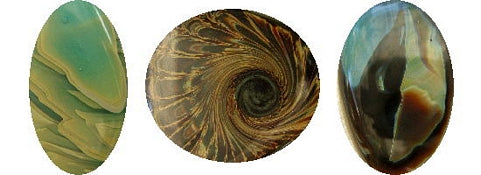
If you have ever been to a glass blower’s studio and observed them blowing glass, you know that every piece doesn’t turn out as planned. The pieces that don’t stand straight, the pieces that get knocked over and broken, and the pieces that are just not right can find a new life by being shaped, ground, and/or tumbled to turn them into smooth glass cabochons.
Dichroic Glass
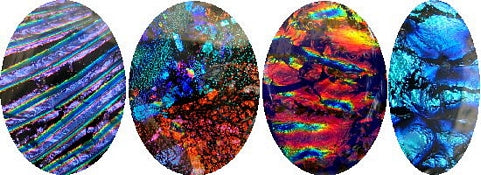
Dichroic (di-crow-ic) glass cabochons are created by glass artists from pieces of raw dichroic glass. They cut and piece the pieces of glass, taking them in and out of the kiln, till they get the colors and patterns they are looking for. Some glass may only be fired a few times - some are fired as many as ten times. They say that these fully fused cabs can be dropped on concrete without breaking, but I don’t have the guts to try it. The end result are stones with a wonderful range of colors and patterns that are incredibly frustrating to photograph or describe.
There is a typical reaction from people that have only seen the dichroic pieces on my web site and then get to see it in person - WOW. I’ve heard more than once that the pictures on the web site are "dead" while the actual pieces are full of life. I have a very hard time showing the true beauty of dichroic glass. The more complex it is, the more layers in the glass, the harder it is to get all of the colors to show. It is like the camera sees the top layer and doesn’t catch all of the other colors sometimes. And on top of all of that, the colors will change with different lights. I do the best I can to give you a true feel for what the pendant looks like. I believe that when you get the pendant, you will have a pendant that looks like you expect or better.
For the techies - dichroic glass is defined as glass that manifests dichroism. Dichroism is an optical effect observed in certain colored crystals where two different colors are seen when the crystals are viewed from different angles. (If several different colors are seen, it is pleochroism.) As with so many things in our lives, dichroic coatings come to us via the space race, where I believe it was first used either to create reflective face shields for astronaut helmets or on mirrors for satellites. Dichroic coatings have many uses today, including polarized sunglasses, fiber optics, infrared lasers, and the like. To make glass dichroic, multiple thin layers of metal oxides such as titanium, silicon, and magnesium are vaporized onto its surface. This causes the glass to transmit one color while reflecting a different color. Additional colors come out when the glass is viewed at an angle. The composition of the metal oxides and the number of layers determine the colors seen.
When glass artists buy the "raw" dichroic glass they use to make their creations, they are interested in the transmitted color, the shift color, and the reflected color.The transmitted color is seen by viewing the glass straight on in transmitted light. The shift color is seen when the glass is turned to about a 45-degree angle. When there is no transmitted light, as when it is placed on a black background, the color seen is the reflected color. Glass artists work with "raw" dichroic glass to create dichroic glass cabochons seen in the jewelry on this site. They may piece together various dichroic glass fragments and/or use multiple layers of dichroic glass. When they fuse the glass, transformations occur. As the glass heats/cools, the glass and coating expand/contract at different rates, causing the coating to separate from the glass as it heats and create new surface patterns as it cools. As each layer is added, the heating/cooling process is repeated. After the first firing, which takes several hours, each piece is ground to a smooth shape and then fired at least one more time. Depending on the artist, pieces may be fired many times, with dichroic glass fragments added before each firing. The light play between the different layers adds to the depth of the colors seen. The color of the base material that the layers are built upon (often black or red) also plays into what colors the end piece displays.
Finished cabochons show both the artist’s range of knowledge of their media and their individual style. I am not aware of any official grading system for dichroic glass. As you talk to various artists, you find that in judging dichroic glass, they focus on the depth of the colors (ie: how many layers of glass), the patterns created, and how well the cabochon has been finished (ie: do they have rough edges, do the colors slop over the edge, etc).
Dichroic glass cabs are wonderfully unique.
Murano Glass
Murano glass comes from the island of Murano, a short boat ride from Venice, Italy.
Art Glass

If you have ever been to a glass blower’s studio and observed them blowing glass, you know that every piece doesn’t turn out as planned. The pieces that don’t stand straight, the pieces that get knocked over and broken, and the pieces that are just not right can find a new life by being shaped, ground, and/or tumbled to turn them into smooth glass cabochons.
Dichroic Glass

Dichroic (di-crow-ic) glass cabochons are created by glass artists from pieces of raw dichroic glass. They cut and piece the pieces of glass, taking them in and out of the kiln, till they get the colors and patterns they are looking for. Some glass may only be fired a few times - some are fired as many as ten times. They say that these fully fused cabs can be dropped on concrete without breaking, but I don’t have the guts to try it. The end result are stones with a wonderful range of colors and patterns that are incredibly frustrating to photograph or describe.
There is a typical reaction from people that have only seen the dichroic pieces on my web site and then get to see it in person - WOW. I’ve heard more than once that the pictures on the web site are "dead" while the actual pieces are full of life. I have a very hard time showing the true beauty of dichroic glass. The more complex it is, the more layers in the glass, the harder it is to get all of the colors to show. It is like the camera sees the top layer and doesn’t catch all of the other colors sometimes. And on top of all of that, the colors will change with different lights. I do the best I can to give you a true feel for what the pendant looks like. I believe that when you get the pendant, you will have a pendant that looks like you expect or better.
For the techies - dichroic glass is defined as glass that manifests dichroism. Dichroism is an optical effect observed in certain colored crystals where two different colors are seen when the crystals are viewed from different angles. (If several different colors are seen, it is pleochroism.) As with so many things in our lives, dichroic coatings come to us via the space race, where I believe it was first used either to create reflective face shields for astronaut helmets or on mirrors for satellites. Dichroic coatings have many uses today, including polarized sunglasses, fiber optics, infrared lasers, and the like. To make glass dichroic, multiple thin layers of metal oxides such as titanium, silicon, and magnesium are vaporized onto its surface. This causes the glass to transmit one color while reflecting a different color. Additional colors come out when the glass is viewed at an angle. The composition of the metal oxides and the number of layers determine the colors seen.
When glass artists buy the "raw" dichroic glass they use to make their creations, they are interested in the transmitted color, the shift color, and the reflected color.The transmitted color is seen by viewing the glass straight on in transmitted light. The shift color is seen when the glass is turned to about a 45-degree angle. When there is no transmitted light, as when it is placed on a black background, the color seen is the reflected color. Glass artists work with "raw" dichroic glass to create dichroic glass cabochons seen in the jewelry on this site. They may piece together various dichroic glass fragments and/or use multiple layers of dichroic glass. When they fuse the glass, transformations occur. As the glass heats/cools, the glass and coating expand/contract at different rates, causing the coating to separate from the glass as it heats and create new surface patterns as it cools. As each layer is added, the heating/cooling process is repeated. After the first firing, which takes several hours, each piece is ground to a smooth shape and then fired at least one more time. Depending on the artist, pieces may be fired many times, with dichroic glass fragments added before each firing. The light play between the different layers adds to the depth of the colors seen. The color of the base material that the layers are built upon (often black or red) also plays into what colors the end piece displays.
Finished cabochons show both the artist’s range of knowledge of their media and their individual style. I am not aware of any official grading system for dichroic glass. As you talk to various artists, you find that in judging dichroic glass, they focus on the depth of the colors (ie: how many layers of glass), the patterns created, and how well the cabochon has been finished (ie: do they have rough edges, do the colors slop over the edge, etc).
Dichroic glass cabs are wonderfully unique.
Murano Glass
Murano glass comes from the island of Murano, a short boat ride from Venice, Italy.