 Unique, One-of-a-Kind Settings for Unique, One-of-a-Kind Stones
Ammolite
Ammolite ~~ Ammonite ~~ Unearthed ~~ Misc Info ~~ Gem Stones ~~ Lore ~~ Rockhounds
Good Luck Stone ~ Prosperity Stone ~ Romance Stone
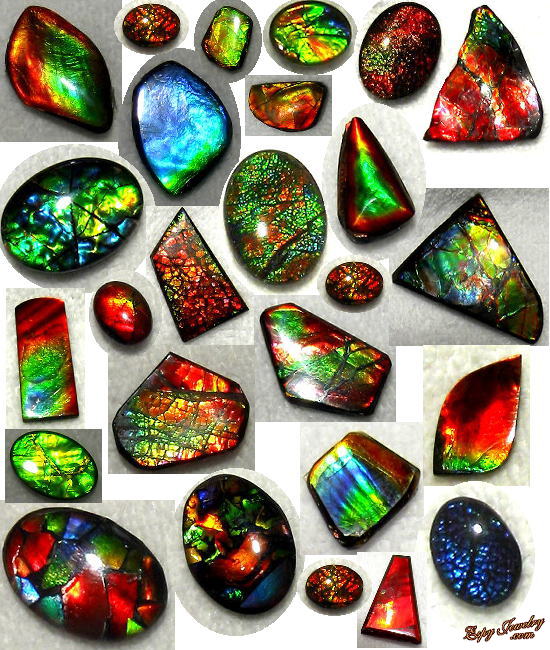
Ammolite is my favorite gemstone. No other gem comes in such a range of colors and patterns or has such vivid iridescence. Ammolite formed in Alberta, Canada from the shells of ancient, extinct ammonites and is a very rare gem. Most people in the US have never seen or heard of it, unless they have been a cruise recently. Although a Canadian gemstone, ammolite jewelry seems to be popular on cruise lines and in their ports-of-call, especially in Alaska and St.Thomas.
If you have never seen ammolite, please realize that it is almost always on gray shale. In other words, one side is gem and the other side is shale. Only occasionally is the gem layer thick enough to produce a 2-sided gem.
Also, please realize that ammolite is highly reactive to light. The light source, the angle and intensity of the light, and your viewing angle will all impact the colors seen. As you turn the stone, it can go completely dark or completely explode into color.
Ammolite is soft, like opal and composed of aragonite, like pearls. Like opals and pearls, ammolite needs some tender, loving care. I like to think of ammolite as the romance stone, because it is full of warmth, fire, life, and unexpected changes. My wedding ring is ammolite. Unlike a cold, hard diamond that can basically be ignored, ammolite requires a little extra thought. Each time I look at it, I am reminded that relationships, like ammolite, can not be taken for granted - and to go and do something nice for my husband.
Each piece of ammolite is unique and different. If you fall in love with a stone, buy it. You will never find another one exactly like it again! If you think you don’t like ammolite, you just have not found your piece yet.
What Makes The Colors?
Ammolite is full of flash and fire and just about any color you can think of. It is the fossilized shell of the extinct sea creature ammonite (a type of cephalopod mollusk - and no, it is not the same as a snail) found in the Bearpaw Shale Formation of Canada and the US.
The difference between the ammonite fossils found in most of the world and the ammonite fossils found in the Bearpaw Shale Formation is that in the Bearpaw Shale formation the actual shell (ie mother-of-pearl or nacre) has been preserved as part of the fossil. In the rest of the world, the sediment filled in the shell, the fossil formed, and the shell has disintegrated. Somehow, in Alberta, the shell has been preserved as part of the fossil. It is that preserved shell that is the gem ammolite.
Nacre, aka Mother-of-Pearl, is familiar to many people. It forms the interior layer of mollusks, has wonderful iridescence, and can create some wonderful colors. Mollusks secrete aragonite (a form of calcium carbonate) and conchiolin to create the nacre (and also pearls), building it up in layers over time. The thin, overlapping layers of aragonite diffract light - changing the direction and intensity of the light wave and creating interference patterns.
Different mollusks have different colors in their shells. One of the most vividly colored mollusks is paua, a species of abalone. The aragonite plates diffracting the light is part of the explanation for the colors. But why is paua so much more vividly colored than other abalone species? Is it just the species? Are there environmental factors? For example, pearls can be yellowish, pinkish, reddish, etc due to impurities in the waters where the mollusks live.
I have not seen a "for-a-fact" explanation of where the vivid colors of paua or ammolite come from. The waters of the Bearpaw Sea (preceding the Bearpaw Shale Formation) was rich with minerals. There were rivers flowing in from the young Rocky Mountains and there was ash falling in from volcanoes. These minerals could have influenced the shell colors of the ammonite of the Bearpaw Sea.
The preservation of the ammonite shell in the Bearpaw Sea may very well be due to the layer of volcanic ash that sealed the ammonites into what became a mineral rich clay called bentonite. It could also be due to high concentrations of iron & magnesium that somehow impeded oxidation of the shell.
Ammolite is normally found in vivid colors, but ammolite has been found in Alberta in more pastel hues - pinks, light golds, lilacs, baby blues, etc. Who knows exactly what has created the colors we see today. It is probably some combination of the "natural" colors of the ammonite species found in the Bearpaw Sea, the high mineral content coming into the sea from volcanoes during that time period, and the mineral rich clay that it was sealed into.
Ammolite is considered an organic gemstone, as is a pearl. You are normally safe if you treat your ammolite like you would treat your pearls.
Continue Reading
Ammolite ~~ Ammonite ~~ Unearthed ~~ Misc Info ~~ Gem Stones ~~ Lore ~~ Rockhounds
Good Luck Stone ~ Prosperity Stone ~ Romance Stone

Ammolite is my favorite gemstone. No other gem comes in such a range of colors and patterns or has such vivid iridescence. Ammolite formed in Alberta, Canada from the shells of ancient, extinct ammonites and is a very rare gem. Most people in the US have never seen or heard of it, unless they have been a cruise recently. Although a Canadian gemstone, ammolite jewelry seems to be popular on cruise lines and in their ports-of-call, especially in Alaska and St.Thomas.
If you have never seen ammolite, please realize that it is almost always on gray shale. In other words, one side is gem and the other side is shale. Only occasionally is the gem layer thick enough to produce a 2-sided gem.
Also, please realize that ammolite is highly reactive to light. The light source, the angle and intensity of the light, and your viewing angle will all impact the colors seen. As you turn the stone, it can go completely dark or completely explode into color.
Ammolite is soft, like opal and composed of aragonite, like pearls. Like opals and pearls, ammolite needs some tender, loving care. I like to think of ammolite as the romance stone, because it is full of warmth, fire, life, and unexpected changes. My wedding ring is ammolite. Unlike a cold, hard diamond that can basically be ignored, ammolite requires a little extra thought. Each time I look at it, I am reminded that relationships, like ammolite, can not be taken for granted - and to go and do something nice for my husband.
Each piece of ammolite is unique and different. If you fall in love with a stone, buy it. You will never find another one exactly like it again! If you think you don’t like ammolite, you just have not found your piece yet.
What Makes The Colors?
Ammolite is full of flash and fire and just about any color you can think of. It is the fossilized shell of the extinct sea creature ammonite (a type of cephalopod mollusk - and no, it is not the same as a snail) found in the Bearpaw Shale Formation of Canada and the US.
The difference between the ammonite fossils found in most of the world and the ammonite fossils found in the Bearpaw Shale Formation is that in the Bearpaw Shale formation the actual shell (ie mother-of-pearl or nacre) has been preserved as part of the fossil. In the rest of the world, the sediment filled in the shell, the fossil formed, and the shell has disintegrated. Somehow, in Alberta, the shell has been preserved as part of the fossil. It is that preserved shell that is the gem ammolite.
Nacre, aka Mother-of-Pearl, is familiar to many people. It forms the interior layer of mollusks, has wonderful iridescence, and can create some wonderful colors. Mollusks secrete aragonite (a form of calcium carbonate) and conchiolin to create the nacre (and also pearls), building it up in layers over time. The thin, overlapping layers of aragonite diffract light - changing the direction and intensity of the light wave and creating interference patterns.
Different mollusks have different colors in their shells. One of the most vividly colored mollusks is paua, a species of abalone. The aragonite plates diffracting the light is part of the explanation for the colors. But why is paua so much more vividly colored than other abalone species? Is it just the species? Are there environmental factors? For example, pearls can be yellowish, pinkish, reddish, etc due to impurities in the waters where the mollusks live.
I have not seen a "for-a-fact" explanation of where the vivid colors of paua or ammolite come from. The waters of the Bearpaw Sea (preceding the Bearpaw Shale Formation) was rich with minerals. There were rivers flowing in from the young Rocky Mountains and there was ash falling in from volcanoes. These minerals could have influenced the shell colors of the ammonite of the Bearpaw Sea.
The preservation of the ammonite shell in the Bearpaw Sea may very well be due to the layer of volcanic ash that sealed the ammonites into what became a mineral rich clay called bentonite. It could also be due to high concentrations of iron & magnesium that somehow impeded oxidation of the shell.
Ammolite is normally found in vivid colors, but ammolite has been found in Alberta in more pastel hues - pinks, light golds, lilacs, baby blues, etc. Who knows exactly what has created the colors we see today. It is probably some combination of the "natural" colors of the ammonite species found in the Bearpaw Sea, the high mineral content coming into the sea from volcanoes during that time period, and the mineral rich clay that it was sealed into.
Ammolite is considered an organic gemstone, as is a pearl. You are normally safe if you treat your ammolite like you would treat your pearls.
Continue Reading
Ammolite ~~ Ammonite ~~ Unearthed ~~ Misc Info ~~ Gem Stones ~~ Lore ~~ Rockhounds