 Unique, One-of-a-Kind Settings for Unique, One-of-a-Kind Stones
Cabs P-Q
Cabochons Index by Name
A B C D E F G H I J K L M N O P Q R S T U-V W X-Y-Z
Peacock Ore (Bornite)
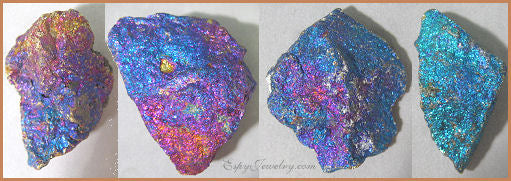
Bornite chunks are sold under the name Peacock Ore. It is a copper iron sulfide, a copper ore. These chunks are completely natural. They start as non-descript black or brown stones and the iridescent colors are basically tarnish. The tarnish layer is very thin and light bouncing between the surface of the stone and the layer of tarnish creates the colors, much like the effect that oil creates on water. Bornite tends to have purple and blue colors of tarnish, but it is often intergrown with chalcopyrite which adds yellows and greens to the tarnish layer.
Chalcopyrite is also a copper iron sulfide and a copper ore. You may see it called copper pyrite or fool’s gold. It starts as a metallic brassy gold color and tarnishes to irredescent greens, yellows, blues, and purples.
There are a lot of metaphysical properties associated with peacock ore, but an obvious one is that it brings joy and happiness.
I love peacock ore as rough, chunky pendants on big nubby sweaters in the wintertime. The texture of the stone against the texture of the sweater really works. While they look heavy, on a large chain over a bulky sweater you don’t feel them.
DO NOT put peacock ore in an ionic cleaner. The colors will change faster than you can rescue it! I think it is the metals in the stone. You’ll get a very lovely color that will improve with age - but it won’t be purple and blue any more.
Peanut Wood - Mohs 7
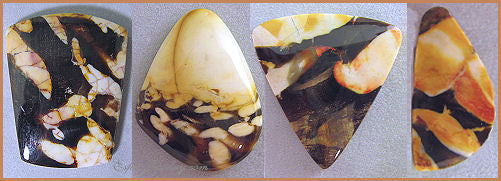
Peanut Wood is a petrified wood from the Kennedy Ranges of Western Australia.
At some point, the wood washed into the ocean and was attacked by shipworms, which are not worms at all but teredo mollusks. The teredos created tunnels in the wood. The wood sunk to the ocean floor and the tunnels filled in with the silica skeletons of tiny marine plankton as they died (radiolarian sediment). This sediment eventually turned into the light tannish areas of the rock.
The remaining wood then also petrified, creating the dark chocolate brown areas of the stone. The contrast of the light tans against the dark, almost-black, browns is quite pretty. While it may technically be called worm wood or teredo wood, peanut wood has a specific color, pattern, and origin that sets it apart from other petrified woods.
Petrified Wood
Petrified wood ("wood turned into stone") is fossilized wood. All of the organic materials have been replaced with minerals while maintaining the orginial structure of the wood, including details such as tree rings. Mohs hardness is usually ~ 7.
Various elements give the petrified wood a variety of colors. Carbon creates black; cobalt creates blues and greens; chromium creates strong greens; copper creates blues and greens; iron oxides create reds, rusts, browns, and yellows; manganese creates pinks and oranges; and manganese oxides create blacks.
Pietersite
See Pietersite under Tiger Eye.
Plume Agate
Agate having soft, fluffy looking inclusions that may resemble feathers, plants, or flowers. The inclusions come in a wide array of colors. Plume agate is usually named based on the geographic location it came from, although sometimes it is named based on the color of the plume.
Potch
See Opal, Common
Purple Opal
See Tiffany Stone
Pyrite - Mohs 6 - 6.5
Pyrite is an iron sulfide also called fool’s gold because its metallic brassy yellow color allows it to be confused with gold.
Pyroxene
Any of a group of common rock-foming silicate minerals found in many igneous and metamorphic rocks. Pyroxenes indicate a high temperature of crystallization with a lack of water. If water were present, an amphibole would have most likely have formed instead.
Quartz
A large group of minerals composed of silicon dioxide. There are 2 major sub-groups:
Quartz Species - macrocrystalline (large, single crystals) - includes amethyst, aventurine, rock crystal, citrine, hawk’s eye, prasiolite, smoky quartz, rose quartz, and tiger’s eye.
Chalcedony Species - cryptocrystalline (finely grained microcrystals) - includes agate, petrified wood, chrysoprase, bloodstone, jasper, carnelian, onyx, sard, moss agate, dendritic agate, sagenitec agate, and plume agate.
For pictures & more information, visit the International Colored Gemstone Assoc.
Cabochons Index by Name
A B C D E F G H I J K L M N O P Q R S T U-V W X-Y-Z
A B C D E F G H I J K L M N O P Q R S T U-V W X-Y-Z
P
Peacock Ore (Bornite)

Bornite chunks are sold under the name Peacock Ore. It is a copper iron sulfide, a copper ore. These chunks are completely natural. They start as non-descript black or brown stones and the iridescent colors are basically tarnish. The tarnish layer is very thin and light bouncing between the surface of the stone and the layer of tarnish creates the colors, much like the effect that oil creates on water. Bornite tends to have purple and blue colors of tarnish, but it is often intergrown with chalcopyrite which adds yellows and greens to the tarnish layer.
Chalcopyrite is also a copper iron sulfide and a copper ore. You may see it called copper pyrite or fool’s gold. It starts as a metallic brassy gold color and tarnishes to irredescent greens, yellows, blues, and purples.
There are a lot of metaphysical properties associated with peacock ore, but an obvious one is that it brings joy and happiness.
I love peacock ore as rough, chunky pendants on big nubby sweaters in the wintertime. The texture of the stone against the texture of the sweater really works. While they look heavy, on a large chain over a bulky sweater you don’t feel them.
DO NOT put peacock ore in an ionic cleaner. The colors will change faster than you can rescue it! I think it is the metals in the stone. You’ll get a very lovely color that will improve with age - but it won’t be purple and blue any more.
Peanut Wood - Mohs 7

Peanut Wood is a petrified wood from the Kennedy Ranges of Western Australia.
At some point, the wood washed into the ocean and was attacked by shipworms, which are not worms at all but teredo mollusks. The teredos created tunnels in the wood. The wood sunk to the ocean floor and the tunnels filled in with the silica skeletons of tiny marine plankton as they died (radiolarian sediment). This sediment eventually turned into the light tannish areas of the rock.
The remaining wood then also petrified, creating the dark chocolate brown areas of the stone. The contrast of the light tans against the dark, almost-black, browns is quite pretty. While it may technically be called worm wood or teredo wood, peanut wood has a specific color, pattern, and origin that sets it apart from other petrified woods.
Petrified Wood
Petrified wood ("wood turned into stone") is fossilized wood. All of the organic materials have been replaced with minerals while maintaining the orginial structure of the wood, including details such as tree rings. Mohs hardness is usually ~ 7.
Various elements give the petrified wood a variety of colors. Carbon creates black; cobalt creates blues and greens; chromium creates strong greens; copper creates blues and greens; iron oxides create reds, rusts, browns, and yellows; manganese creates pinks and oranges; and manganese oxides create blacks.
Pietersite
See Pietersite under Tiger Eye.
Plume Agate
Agate having soft, fluffy looking inclusions that may resemble feathers, plants, or flowers. The inclusions come in a wide array of colors. Plume agate is usually named based on the geographic location it came from, although sometimes it is named based on the color of the plume.
Potch
See Opal, Common
Purple Opal
See Tiffany Stone
Pyrite - Mohs 6 - 6.5
Pyrite is an iron sulfide also called fool’s gold because its metallic brassy yellow color allows it to be confused with gold.
Pyroxene
Any of a group of common rock-foming silicate minerals found in many igneous and metamorphic rocks. Pyroxenes indicate a high temperature of crystallization with a lack of water. If water were present, an amphibole would have most likely have formed instead.
Q
Quartz
A large group of minerals composed of silicon dioxide. There are 2 major sub-groups:
Quartz Species - macrocrystalline (large, single crystals) - includes amethyst, aventurine, rock crystal, citrine, hawk’s eye, prasiolite, smoky quartz, rose quartz, and tiger’s eye.
Chalcedony Species - cryptocrystalline (finely grained microcrystals) - includes agate, petrified wood, chrysoprase, bloodstone, jasper, carnelian, onyx, sard, moss agate, dendritic agate, sagenitec agate, and plume agate.
For pictures & more information, visit the International Colored Gemstone Assoc.
Cabochons Index by Name
A B C D E F G H I J K L M N O P Q R S T U-V W X-Y-Z