 Unique, One-of-a-Kind Settings for Unique, One-of-a-Kind Stones
Cabs R-S
Cabochons Index by Name
A B C D E F G H I J K L M N O P Q R S T U-V W X-Y-Z
Rainbow Calsilica (Cal Silica)- Mohs 3-4
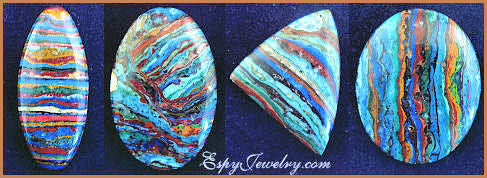
Rainbow Calsilica is a rainbow colored stone from Chihuahua, Mexico. It does not take a super high shine, which makes it a natural with casual clothing - especially jeans. It is right at home with dressier outfits as well and coordinates with a lot of colors. Although I tend to buy striped material, you will also see big, random patterns. It just depends on whether it is cut with the stripes or across the stripes.
Calsilica may or may not be a natural stone. There was controversy when it was first introduced to the market and it continues. Testing was done by some labs, who determined that is was a natural stone. Testing was done by other labs, who determined that it was a man-made product. It is not clear though if the labs that declared it to be man-made were testing "out-of-the-ground" material or stabilized material. Until the mine owner decides to allow a geological expert trusted by the industry into the mine shown in photographs, the controversy will continue.
The greens and blues in the stones are calcite allophane clay. The other colors are silica tinted by trace metals to create reds, browns, tans, yellows, whites, etc. This fits with assertions on the web that calsilica is a by-product from a tile factory - "As they cut brightly colored tiles all day, the colorful slurry runs into a drain pond where over time it actually hardens into a . . . man made accidental rock." This would make it similar to Fordite (baked, built up layers of enamel auto paint).
Calsilica is stabilized in the same manner as turquoise. I don’t really care whether calsilica is a natural stone or turns out to be an elaborate hoax that is really a manmade product. The bottom line is that it is a fun stone that gets lots of comments.
Realgar
Arsenic Sulfide. A major ore of arsenic that was once used for pigments because of its orange to red color. Unfortunately it degrades over time and old paintings that used it to produce reds now show yellows and oranges instead.
Rhodochrosite - Mohs 4
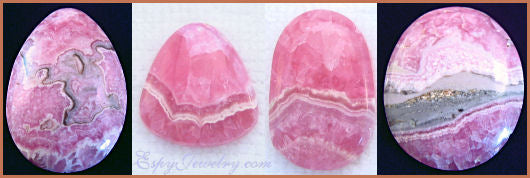
A soft stone that can be brittle, it is prized for its lovely pink-rose color and white markings. Transparent red crystals (no impurities) do occur, but are rare.
Rhodochrosite is a manganese carbonate, a minor ore of manganese, and gets its pink color from the manganese. The white patterns come from other minerals, such as calcites. It often forms in stalactites and stalagmites in caves and in the old, abandoned Incan silver mines. It is found many places, especially in North and South America and Africa, but I find a lot of what I have bought has come from Peru or Argentina. The rhodochrosite I have purchased from Peru has some of the most interesting "bulls-eyes" while that from Argentina often has interesting soft grey patterns in it.
Rhodonite - Mohs 5.5-6.5
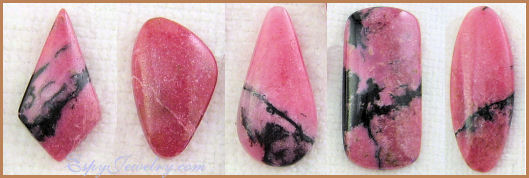
A darker (as compared to rhodochrosite"), rose-red or raspberry color that often has black dendritic inclusions of manganese oxide. Transparent crystals do occur, but are very rare. Rhodonite is a manganese iron magnesium calcium silicate, a minor ore of manganese.
Rhodonite is found many places around the world. The pieces in the picture above are all from Australia and were called "imperial rhodonite" by the lapidary I purchased them from.
Rhodonite-Rhodochrosite
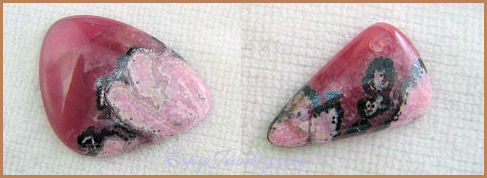
Refers to a stone composed of both rhodonite and rhodochrosite. The interplay of the darker raspberry colored rhodonite and the pink and white of the rhodochrosite can be quite striking - especially when accented with black.
Ruby-Fuchsite (Ruby in Fuchsite) - Mohs 2-3
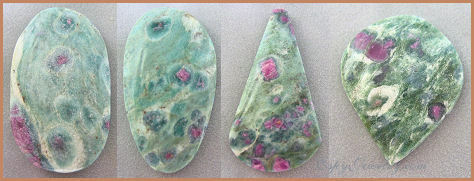
Fuchsite (green) with inclusions of opaque (ie: low grade not suitable for faceting) ruby (red corundum), calcite (white), and sometimes kyanite (blue). You can see the green ranges from a darker green to a light, almost bluish-green. I’m guessing the bluish green color is being influenced by kyanite.
Ruby Fuchsite comes from India. The rough looking area in the first image is actually tiny mica sparkles that were picked up by the camera. Fuchsite is 2-3 on the moh’s scale while ruby is 9. The two different hardnesses can make it challenging to cut.
Comparing Ruby Fuchsite from India to Ruby Zoisite from Africa, the fuchsite is a lighter green and it is quite normal to see white markings in it as well as mica sparkles. I’ve not seen any with black markings, but the stone is such a conglomoration I wouldn’t rule out ever seeing black in it.
Ruby-Zoisite(Ruby in Zoisite) (Anyolite) - Mohs 6.5
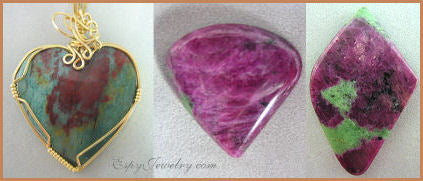
Green zoisite (apple green to darker green) with inclusions of opaque (ie: low grade not suitable for faceting) ruby (red corundum), often with inclusions (speckles or streaks) of horneblende (black).
Ruby Zoisite comes from Africa. The more black in the stone the darker it appears to be. The image on the right shows a stone that is mostly just the ruby, with only a touch of green zoisite showing on the edge. Zoisite and Hornblende are 6.5 on the moh’s scale while ruby is 9. The two different hardnesses can make it challenging to cut.
Comparing Ruby Zoisite from Africa to Ruby Fuchsite from India, the zoisite is a darker green and it is quite normal to see black markings in it. I’ve not seen any with white markings and you won’t see any mica sparkles in zoisite.
Rutilated Quartz - Mohs 7
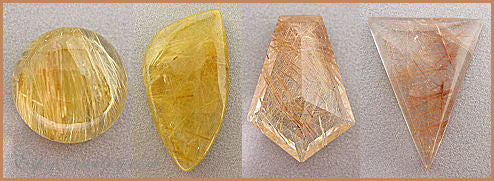
Clear quartz with inclusions of golden to reddish rutile needles.
Stones with black needle-like inclusions are normally Tourmalated Quartz.
Rutile
Titanium oxide (a titanium ore) that is golden yellow to rusty yellow in thin crystals, becoming reddish brown to black as the crystals get thicker.
Microscopic inclusions of rutile in quartz, tourmaline, ruby, sapphire and other gemstones produces effects such as cat’s eye (chatoyancy) and stars (asterism).
Larger inclusions of rutile needles in clear quartz is called Rutilated Quartz.
Sagenite
Depending on who is using the term, they could be referring to Sagenitic Agate or Rutilated Quartz. While rutilated quartz may be a type of sagenite, it has a very defined type of inclusion - rutile. Sagenitic agate, on the other hand, seems to mean there can be various kinds of inclusions, as long as they are needle-like. (Agate is a type of cryptocrystalline quartz.)
Sagenitic Agate (Sagenite)
Agate having needle-like mineral growths. These hair like filaments are often arranged in fans or sunbursts. The inclusions come in a wide array of colors. Inclusions occur where iron oxide, manganese oxide, or other oxides are present when the agate is formed. The oxide minerals grow in the agate when it is in a liquid or gelatinous state. The inclusions grow and are supported by this liquid medium. Sagenite seems to be named based on the geographic location it came from.
Serpentine (Serpentinite, Serpentine Rock) - Mohs 5
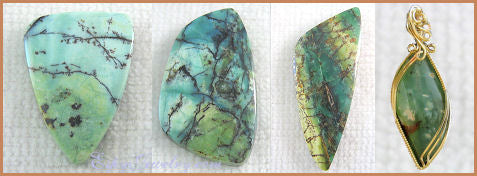
Serpentine refers to a group of predominately green minerals, namely antigorite and chrysotile. Most people will also call rock created from these minerals serpentine, but you will also see it refered to as serpentine rock and serpentinite.
While serpentine is normally some shade of green, it can also be yellow, yellow-green, green-blue, blue, brown, red, black, or white. The color can be fairly uniform or various colors can be mixed together in blotches, streaks, or other patterns. It can be translucent to opaque and may have inclusions.
There are many varieties of serpentine and not many lapidaries will distinquish the stone they are cutting further than serpentine. If a lapidary it cutting it, it is normally in the 4-5 hardness range, although serpentine can be softer.
The kinds of serpentine used for jewelry normally are of the antigorite type, including those called bowenite (apple-green, often interspersed with light spots), verd-antique (green interspersed with white calcite or dolomite veins), and williamsite (translucent oil-green often with black inclusions).
Shattuckite - Mohs 3.5
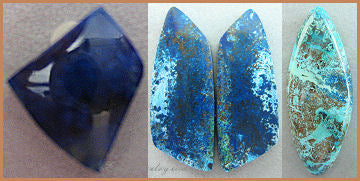
Shattuckite is a relatively rare copper mineral with a deep blue color. It is named after the Shattuck Mine in Bisbee, Arizona, where it was first discovered. Like many of the copper minerals, you may see it more in mixes of copper minerals than by itself. In the pictures above, the first is shattuckite and the second is primarily shattuckite. The third stone is a chrysocolla based mix of copper minerals. Midway on the right edge you can see some of the unique blue color of shattuckite.
Sodalite - Mohs 5.5-6
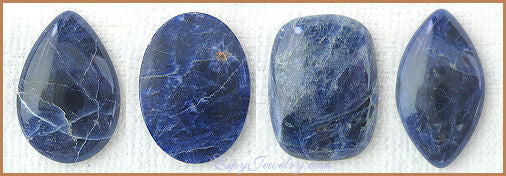
Sodalite, as most people are familiar with it, is a dark to light blue stone that often has white veins of calcite in it. It can be a component of lapis lazuli and can have a similar appearance, but the tone of blue is different and it does not have any pyrite flecks.
Sodalite does come in other colors, including grays/whites, green, yellow, and pink.
Sodalite Group - a group of related minerals named for the most common member, sodalite. Also includes Hauyne, Lazurite, Nosean.
Sonoran Sunrise (Sonoran Sunset, Sonora Sunrise, Sonoran Sunrise)
See cuprite.
Stalactite, Stalagmite
Mineral formations found on the ceilings and floors of caves. Stalactites are icicle-shaped. They form as minerals precipitate from groundwater seeping through the roof of the cave. As the water falls to the floor of the cave, minerals also precipitate and accumulate there. The mineral deposits on the floor grow upward and are called stalagmites. As they grow, stalactites and stalagmites can meet and create giant columns.
Stibnite (Misspelling: Stebnite)
A steel-gray to silver ore of antimony with a metallic luster. Crystal formations of stibnite can be prized specimens.
Antimony is a metal (or semi-metal, since it is not as shiny and malleable as other metals). One of its leading uses is in the manufacture of flame retardants. It is also used as a pigmant (antimony oxide is brilliant yellow) and as a hardening alloy for lead.
Sugilite - Mohs 6-6.5
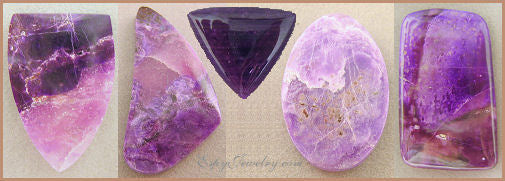
Sugilite is wonderfully purple gemstone from South Africa. Although sugilite does occur elsewhere in the world and in other colors, the manganese in the South African stones give them a range of purple from vivid reddish purple to violet (bluish purple) to dark purple. The manganese can also appear as black spots in the stones and you will sometimes see inclusions of bluish-grey richterite. Most sugilite is opaque, but there are truanslucent specimens. When translucent, it is often referred to as "gel" or "gemmy".
Cabochons Index by Name
A B C D E F G H I J K L M N O P Q R S T U-V W X-Y-Z
A B C D E F G H I J K L M N O P Q R S T U-V W X-Y-Z
R
Rainbow Calsilica (Cal Silica)- Mohs 3-4

Rainbow Calsilica is a rainbow colored stone from Chihuahua, Mexico. It does not take a super high shine, which makes it a natural with casual clothing - especially jeans. It is right at home with dressier outfits as well and coordinates with a lot of colors. Although I tend to buy striped material, you will also see big, random patterns. It just depends on whether it is cut with the stripes or across the stripes.
Calsilica may or may not be a natural stone. There was controversy when it was first introduced to the market and it continues. Testing was done by some labs, who determined that is was a natural stone. Testing was done by other labs, who determined that it was a man-made product. It is not clear though if the labs that declared it to be man-made were testing "out-of-the-ground" material or stabilized material. Until the mine owner decides to allow a geological expert trusted by the industry into the mine shown in photographs, the controversy will continue.
The greens and blues in the stones are calcite allophane clay. The other colors are silica tinted by trace metals to create reds, browns, tans, yellows, whites, etc. This fits with assertions on the web that calsilica is a by-product from a tile factory - "As they cut brightly colored tiles all day, the colorful slurry runs into a drain pond where over time it actually hardens into a . . . man made accidental rock." This would make it similar to Fordite (baked, built up layers of enamel auto paint).
Calsilica is stabilized in the same manner as turquoise. I don’t really care whether calsilica is a natural stone or turns out to be an elaborate hoax that is really a manmade product. The bottom line is that it is a fun stone that gets lots of comments.
Realgar
Arsenic Sulfide. A major ore of arsenic that was once used for pigments because of its orange to red color. Unfortunately it degrades over time and old paintings that used it to produce reds now show yellows and oranges instead.
Rhodochrosite - Mohs 4

A soft stone that can be brittle, it is prized for its lovely pink-rose color and white markings. Transparent red crystals (no impurities) do occur, but are rare.
Rhodochrosite is a manganese carbonate, a minor ore of manganese, and gets its pink color from the manganese. The white patterns come from other minerals, such as calcites. It often forms in stalactites and stalagmites in caves and in the old, abandoned Incan silver mines. It is found many places, especially in North and South America and Africa, but I find a lot of what I have bought has come from Peru or Argentina. The rhodochrosite I have purchased from Peru has some of the most interesting "bulls-eyes" while that from Argentina often has interesting soft grey patterns in it.
Rhodonite - Mohs 5.5-6.5

A darker (as compared to rhodochrosite"), rose-red or raspberry color that often has black dendritic inclusions of manganese oxide. Transparent crystals do occur, but are very rare. Rhodonite is a manganese iron magnesium calcium silicate, a minor ore of manganese.
Rhodonite is found many places around the world. The pieces in the picture above are all from Australia and were called "imperial rhodonite" by the lapidary I purchased them from.
Rhodonite-Rhodochrosite

Refers to a stone composed of both rhodonite and rhodochrosite. The interplay of the darker raspberry colored rhodonite and the pink and white of the rhodochrosite can be quite striking - especially when accented with black.
Ruby-Fuchsite (Ruby in Fuchsite) - Mohs 2-3

Fuchsite (green) with inclusions of opaque (ie: low grade not suitable for faceting) ruby (red corundum), calcite (white), and sometimes kyanite (blue). You can see the green ranges from a darker green to a light, almost bluish-green. I’m guessing the bluish green color is being influenced by kyanite.
Ruby Fuchsite comes from India. The rough looking area in the first image is actually tiny mica sparkles that were picked up by the camera. Fuchsite is 2-3 on the moh’s scale while ruby is 9. The two different hardnesses can make it challenging to cut.
Comparing Ruby Fuchsite from India to Ruby Zoisite from Africa, the fuchsite is a lighter green and it is quite normal to see white markings in it as well as mica sparkles. I’ve not seen any with black markings, but the stone is such a conglomoration I wouldn’t rule out ever seeing black in it.
Ruby-Zoisite(Ruby in Zoisite) (Anyolite) - Mohs 6.5

Green zoisite (apple green to darker green) with inclusions of opaque (ie: low grade not suitable for faceting) ruby (red corundum), often with inclusions (speckles or streaks) of horneblende (black).
Ruby Zoisite comes from Africa. The more black in the stone the darker it appears to be. The image on the right shows a stone that is mostly just the ruby, with only a touch of green zoisite showing on the edge. Zoisite and Hornblende are 6.5 on the moh’s scale while ruby is 9. The two different hardnesses can make it challenging to cut.
Comparing Ruby Zoisite from Africa to Ruby Fuchsite from India, the zoisite is a darker green and it is quite normal to see black markings in it. I’ve not seen any with white markings and you won’t see any mica sparkles in zoisite.
Rutilated Quartz - Mohs 7

Clear quartz with inclusions of golden to reddish rutile needles.
Stones with black needle-like inclusions are normally Tourmalated Quartz.
Rutile
Titanium oxide (a titanium ore) that is golden yellow to rusty yellow in thin crystals, becoming reddish brown to black as the crystals get thicker.
Microscopic inclusions of rutile in quartz, tourmaline, ruby, sapphire and other gemstones produces effects such as cat’s eye (chatoyancy) and stars (asterism).
Larger inclusions of rutile needles in clear quartz is called Rutilated Quartz.
S
Sagenite
Depending on who is using the term, they could be referring to Sagenitic Agate or Rutilated Quartz. While rutilated quartz may be a type of sagenite, it has a very defined type of inclusion - rutile. Sagenitic agate, on the other hand, seems to mean there can be various kinds of inclusions, as long as they are needle-like. (Agate is a type of cryptocrystalline quartz.)
Sagenitic Agate (Sagenite)
Agate having needle-like mineral growths. These hair like filaments are often arranged in fans or sunbursts. The inclusions come in a wide array of colors. Inclusions occur where iron oxide, manganese oxide, or other oxides are present when the agate is formed. The oxide minerals grow in the agate when it is in a liquid or gelatinous state. The inclusions grow and are supported by this liquid medium. Sagenite seems to be named based on the geographic location it came from.
Serpentine (Serpentinite, Serpentine Rock) - Mohs 5

Serpentine refers to a group of predominately green minerals, namely antigorite and chrysotile. Most people will also call rock created from these minerals serpentine, but you will also see it refered to as serpentine rock and serpentinite.
While serpentine is normally some shade of green, it can also be yellow, yellow-green, green-blue, blue, brown, red, black, or white. The color can be fairly uniform or various colors can be mixed together in blotches, streaks, or other patterns. It can be translucent to opaque and may have inclusions.
There are many varieties of serpentine and not many lapidaries will distinquish the stone they are cutting further than serpentine. If a lapidary it cutting it, it is normally in the 4-5 hardness range, although serpentine can be softer.
The kinds of serpentine used for jewelry normally are of the antigorite type, including those called bowenite (apple-green, often interspersed with light spots), verd-antique (green interspersed with white calcite or dolomite veins), and williamsite (translucent oil-green often with black inclusions).
Shattuckite - Mohs 3.5

Shattuckite is a relatively rare copper mineral with a deep blue color. It is named after the Shattuck Mine in Bisbee, Arizona, where it was first discovered. Like many of the copper minerals, you may see it more in mixes of copper minerals than by itself. In the pictures above, the first is shattuckite and the second is primarily shattuckite. The third stone is a chrysocolla based mix of copper minerals. Midway on the right edge you can see some of the unique blue color of shattuckite.
Sodalite - Mohs 5.5-6

Sodalite, as most people are familiar with it, is a dark to light blue stone that often has white veins of calcite in it. It can be a component of lapis lazuli and can have a similar appearance, but the tone of blue is different and it does not have any pyrite flecks.
Sodalite does come in other colors, including grays/whites, green, yellow, and pink.
Sodalite Group - a group of related minerals named for the most common member, sodalite. Also includes Hauyne, Lazurite, Nosean.
Sonoran Sunrise (Sonoran Sunset, Sonora Sunrise, Sonoran Sunrise)
See cuprite.
Stalactite, Stalagmite
Mineral formations found on the ceilings and floors of caves. Stalactites are icicle-shaped. They form as minerals precipitate from groundwater seeping through the roof of the cave. As the water falls to the floor of the cave, minerals also precipitate and accumulate there. The mineral deposits on the floor grow upward and are called stalagmites. As they grow, stalactites and stalagmites can meet and create giant columns.
Stibnite (Misspelling: Stebnite)
A steel-gray to silver ore of antimony with a metallic luster. Crystal formations of stibnite can be prized specimens.
Antimony is a metal (or semi-metal, since it is not as shiny and malleable as other metals). One of its leading uses is in the manufacture of flame retardants. It is also used as a pigmant (antimony oxide is brilliant yellow) and as a hardening alloy for lead.
Sugilite - Mohs 6-6.5

Sugilite is wonderfully purple gemstone from South Africa. Although sugilite does occur elsewhere in the world and in other colors, the manganese in the South African stones give them a range of purple from vivid reddish purple to violet (bluish purple) to dark purple. The manganese can also appear as black spots in the stones and you will sometimes see inclusions of bluish-grey richterite. Most sugilite is opaque, but there are truanslucent specimens. When translucent, it is often referred to as "gel" or "gemmy".
Cabochons Index by Name
A B C D E F G H I J K L M N O P Q R S T U-V W X-Y-Z